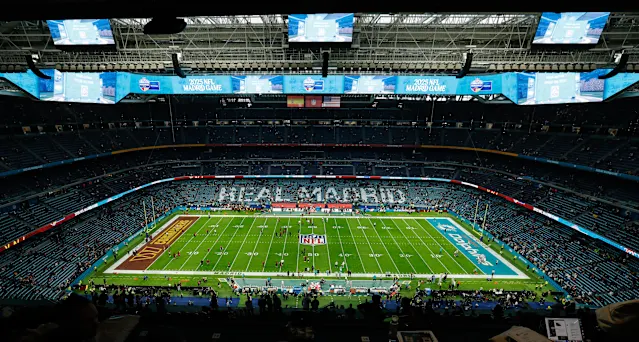
Nine NFL international games in 2026 is way too many, and it’s going to make Sundays worse for the fans who actually pay the bills. One or two overseas games are a fun novelty. Nine turns it into a gimmick that chips away at home-field football and jacks up season ticket pain.
NFL International Games in 2026: Nine Games Isn’t “Special” Anymore
When international games were rare, it felt like an event. You’d get one London game, maybe a Mexico City game, and it was something different. You didn’t have to pretend it was fair. You didn’t have to pretend it was normal. It was just a weird little football holiday.
Now we’re at nine in 2026, and the league keeps floating the long-term dream where every team plays one international game each season. That sounds like “progress” until you realize what that means on the ground. In a world where that becomes standard, about half the league is giving up a true home date every year. That’s not a novelty. That’s the league re-shuffling the value you paid for and acting like you should clap.
And the worst part is the NFL is going to keep calling these “home games” for marketing reasons. They’re not home games. They’re neutral-site games with your logo on the field, and your season ticket holders staring at a calendar thinking, great, I just lost my November game and got a coupon code as compensation.
The Logistics Nightmare: International Travel Makes Bad Football More Likely
The NFL loves to sell this like it’s smooth. Planes, hotels, practice fields, done. That’s not how pro football works. These teams are built on routine, timing, and the smallest edges. You mess with sleep, recovery, travel, practice rhythm, and you get sloppy football.
Time zones are not a vibe. They’re a real problem. Your body clock gets thrown off, your legs feel heavy, and even if the coaches are trying to manage it, you’re still asking players to do one of the most violent jobs on earth after a travel week that looks like a corporate roadshow.
Now think about Australia. That’s not “a long flight.” That’s a whole different world. The travel is brutal, the recovery is weird, and you’re asking a roster full of banged-up guys to be sharp and explosive. Can it be done? Sure. Will it look like a normal NFL Sunday? A lot of the time, no.
And it’s not just the flight. It’s the week. Practice schedules change. Meeting times change. Meal timing changes. Sleep timing changes. Even stuff like equipment logistics and field familiarity changes. Football is a precision sport pretending it’s immune to chaos. It isn’t.
Why International NFL Games Often Feel Like Duds
You said it perfectly: teams aren’t always playing to win, they’re playing to survive. That’s what these international games turn into a lot of the time. Coaches get conservative. Quarterbacks hold the ball. Offenses shrink. Nobody wants to be the team that looks unprepared on a global stage, so they call a game like they’re protecting themselves, not attacking the opponent.
That leads to exactly the kind of football fans hate. Punt trading. Red zone tightness. Field goals instead of touchdowns. Long stretches where nobody wants to take a risk. It’s not that the players don’t care. It’s that the environment encourages “safe” football.
And safe football is boring football.
The NFL Won’t Send Marquee Matchups, So What’s the Point?
If the league really believed these games were the premium global showcase they claim, you’d see premium matchups. You’d see division rivalries. You’d see games with real playoff stakes later in the year. You’d see the kind of schedule that makes you say, okay, I get it, they’re putting the best product on the biggest stage.
That’s not what we get most of the time.
Most international slates look like the league pulling names out of a hat while trying not to mess up its best TV windows back home. They’ll toss one decent matchup in there once in a while, then fill the rest with games that feel like “inventory.” It’s the NFL equivalent of putting the good merch in the front window and sending the leftovers to the outlet store.
Fans overseas deserve better than that too, by the way. If you’re going to ask London, Munich, Madrid, Paris, and Rio to show up like it’s the Super Bowl, give them something that actually feels like it.
Why Some Countries Just Aren’t Great Fits for Regular Season NFL Games
This is where the league gets too cute.
I’m not saying the sport can’t grow. I’m saying the NFL keeps pretending every country is equally practical for a regular season product, and that’s nonsense.
London works because it’s been built up for years. There are systems in place. The stadium setups are familiar. The league knows how to run that week. Germany has shown it can show up too, and the crowds are legit.
But the NFL’s trying to turn this into a world tour, and not every stop is equally clean for a regular season product.
Mexico City is fun and loud, but altitude is real. You can say “pro athletes should handle it,” and sure, they can. But why add another variable to a league that already swings on one slip, one hamstring, one bad quarter? It’s not just about conditioning. It’s about the game being played in an environment that’s different from what teams train for all season.
Brazil and Rio bring their own concerns, and I’m not even talking about fan passion. I’m talking about the total operation: field conditions, weather variables, the calendar conflicts with soccer and concerts, the travel, the security planning, the whole machine that has to run perfectly for football to look like football.
Then you’ve got Australia. Again, awesome idea on a poster. Brutal idea in a sport where injuries stack up by October. The distance alone turns it into something closer to a mini-camp trip than a normal road game.
Season Ticket Prices Go Up When Home Games Disappear
Here’s the angle that should make every fan mad, even the ones who love the “global game” idea.
If your team gives up a home game, your costs do not go down.
They will dress it up as “value.” They will offer credits. They will offer presale access. They will offer special events. They will give you a glossy email with a nice font. But you are still paying for the same seat in the same stadium with the same parking bill and the same concession prices that keep creeping up.
Now picture the long-term goal: every team plays an international game each year. In that world, you’ve basically got 16 fanbases per season dealing with a “missing” true home game. What happens next? Scarcity. Less supply of home games, same demand, higher prices. It’s the simplest business math there is.
And it’s not just the ticket. It’s everything around the ticket. You plan your fall around those Sundays. You bring your kid. You bring your dad. You tailgate. You make it your thing. Now the league wants to take one of those Sundays and ship it overseas, then tell you to be excited because you can watch it at 9:30 a.m. on TV.
That’s not excitement. That’s losing something.
The NFL Is Gambling With Home-Field Advantage
Home field in the NFL is real. Crowd noise affects communication. Familiar stadium sightlines matter. Travel fatigue matters. Routine matters.
When you move games to neutral sites, you flatten those edges. You can call it “fair.” You can call it “global.” But you’re still changing the competitive environment.
And if you’re the team designated as the “home” team, you’re the one giving something up. The fans lose a true home date. The players lose a true home week. The coaching staff loses a normal prep rhythm. All for what? A branding win for the league office and a pile of money that doesn’t trickle down to the person paying $14 for a beer.
What the NFL Should Do Instead
Here’s the compromise: keep it at one or two international games a year and make them real events. Treat them like a showcase, not a quota.
If the NFL wants global growth, there are smarter ways to do it without messing with standings and home schedules. Build youth programs. Build flag football. Build international fan events around the draft. Take teams overseas for joint practices and preseason tours. Do all the stuff that grows the brand without turning regular season Sundays into travel experiments.
Because that’s what this becomes when it gets too big: an experiment. And fans aren’t paying season ticket money to be part of a test run.
Bottom Line: One or Two Is Fun, Nine Is a Tax
International games can be fun. They can be cool. They can be a great TV morning once in a while.
But the more the NFL leans on them, the more it turns into lower-scoring, tighter, survival-style football, and the more it turns into fans paying more for less. If the league wants to go global, fine. Just stop acting like the cost isn’t landing on the people who’ve been holding this thing up for decades.
Keep it at one or two. Make it a real showcase. Give people a reason to care. Don’t water down the season and then wonder why the games feel flat.
ROLL WITH HAIL MARY MEDIA
Like this kind of chaos? Stay tapped in.
Follow us on X for live reactions, bad beats, and daily sports rants.
FOLLOW @HAILMARYMEDIA_ ON XNot done yet? CLICK HERE for more blogs.