
MLB can flirt with prediction markets, but after FTX and a fresh pitch-fixing case, baseball should keep its distance. Fans are already drowning in gambling ads, and this is how sports get unwatchable.
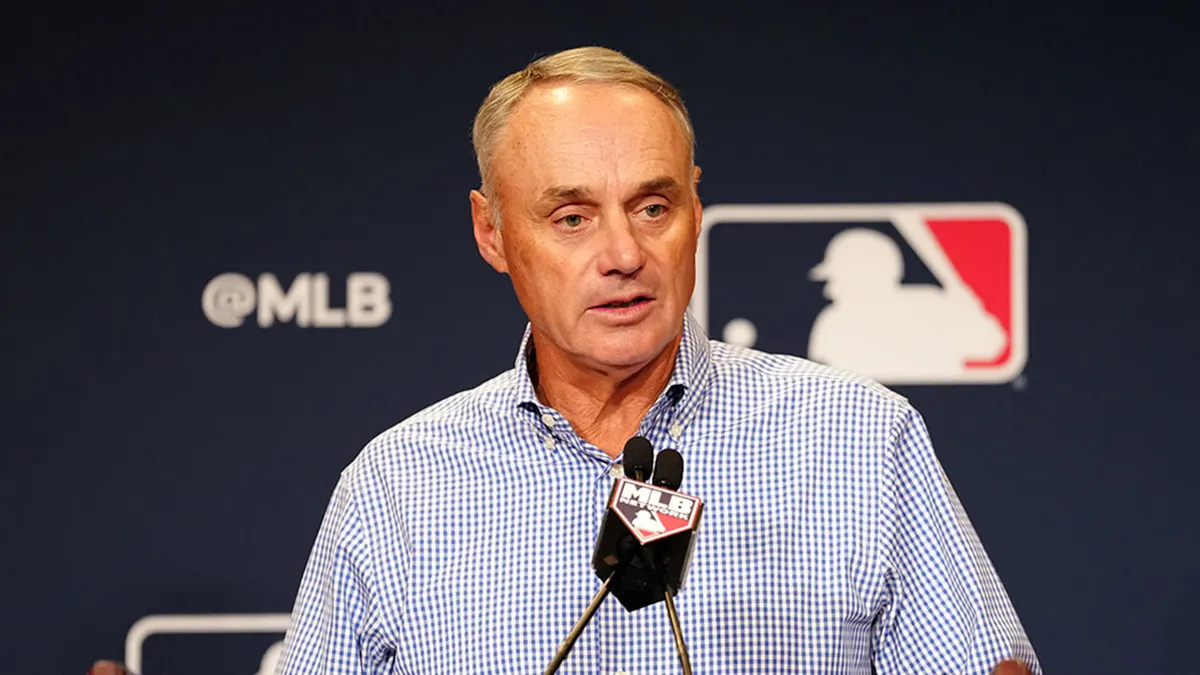
Baseball doesn’t need another “innovative partnership” that sounds smart in a boardroom and feels gross on your couch. Rob Manfred has openly talked about MLB potentially doing business with prediction market platforms like Kalshi and Polymarket, and I’m sure the pitch is the same as always: integrity monitoring, data access, modern fan engagement.
Here’s the thing. MLB’s track record with shiny new money is shaky, the sport is actively dealing with a gambling scandal tied to pitch-level props, and fans are turning on the constant betting noise. You don’t fix that by adding another lane for people to gamble on your product.
MLB prediction markets sound “fine” until you remember what MLB does with new money
On the surface, prediction markets are just another way people put money on outcomes. Instead of betting against “the house,” you’re buying and selling contracts that settle at $1 if something happens and $0 if it doesn’t. In plain English, it’s still wagering, just with a finance costume.
MLB’s argument is basically, “If this is happening anyway, we might as well be involved so we can monitor it.” Manfred has said owners were briefed about the possibility of partnering with Polymarket and Kalshi, and the league already sees gambling data as part of integrity monitoring.
But MLB doesn’t get to sell “trust us, it’s for integrity” when the fan experience has been trending in one direction for years: more betting tie-ins, more odds chatter, more promos, more “watch the game through your wallet” nonsense. Even if prediction markets are technically different, they’ll land the same way with real fans. It’s more gambling packaged as entertainment, right when people are begging for less of it.
The FTX deal is why MLB has no credibility on “we did our homework”
If you want the simplest reason MLB should pump the brakes, it’s sitting right there in recent history: FTX.
MLB announced a partnership with FTX.US in June 2021, and the most memorable part wasn’t a banner on a website. It was an FTX patch on umpire uniforms, starting with the All-Star Game that July, then carried through regular season and postseason games. When FTX collapsed and filed for bankruptcy, MLB ended the sponsorship and dropped the patches.
That’s the point people keep skipping. MLB didn’t just take money. MLB put that brand on the officials, the people who are supposed to represent order and fairness. It told fans, “This is safe enough to ride on the rulebook.” Then it blew up in everyone’s face.
So when MLB says prediction markets are the next frontier and “we’ll handle it responsibly,” fans are going to hear, “Sure, just like last time.” And honestly, they’re not wrong to be skeptical.
The Guardians gambling scandal is the nightmare scenario, and it’s happening right now
This is where the whole conversation stops being theoretical.
Federal prosecutors allege Cleveland Guardians pitchers Emmanuel Clase and Luis Ortiz were involved in a scheme tied to prop bets, including allegations of fixed pitches. The reporting around the case includes claims about manipulation across multiple seasons, bettors profiting hundreds of thousands, and a trial date set for May 4, 2026.
You don’t need to be a conspiracy guy to see the risk here. The more the betting ecosystem rewards tiny, isolated moments, the easier it is for someone to nudge one moment without “throwing the game.” A single pitch. A single walk. A single first-inning hit allowed. That’s the danger zone, because it’s the kind of action a player can influence without the scoreboard screaming that something’s wrong.
Now imagine MLB helps normalize prediction markets while this case is still fresh. Even if the league’s internal integrity people do great work, the public perception is going to be brutal: baseball is expanding the gambling universe at the exact moment it’s being reminded why gambling can rot the foundation.
MLB literally warned its own players about prediction markets, and now it wants a partnership
This part is almost funny if it wasn’t so on-brand.
In December 2025, MLB sent a memo warning players that the league’s gambling rules also apply to prediction markets tied to baseball. That tells you MLB already views this stuff as gambling-adjacent at minimum, risky enough that players need a clear “don’t touch it” message.
So what are we doing here? “Players can’t participate because integrity,” but “the league might partner because integrity.” That’s not integrity. That’s convenience.
Fans aren’t stupid. They can smell a double standard from the upper deck. If prediction markets are too dangerous for players to be around, they’re too messy for MLB to slap its logo on and promote to everyone else.
Fans are tapped out on gambling, and the numbers back it up
Here’s the part leagues hate hearing: a lot of people are just tired.
A Pew Research Center survey from July 8 to Aug. 3, 2025 found 43% of U.S. adults said legal sports betting is a bad thing for society, and 40% said it’s bad for sports. Both numbers jumped compared to 2022.
That’s not “pearl clutching.” That’s the mainstream getting annoyed and uneasy. And you can feel it when you watch games. Pregame shows talking lines. In-game odds updates. Broadcast reads. “Boost” promos. It never ends.
MLB is supposed to be the sport you put on after work, crack a beer, and let the night breathe. If the viewing experience becomes a nonstop push to wager, a lot of folks will just stop watching. Not because they’re offended, but because it’s exhausting.
Prediction markets are a regulatory food fight MLB doesn’t want to star in
Sportsbooks are regulated state by state. Prediction markets like Kalshi are overseen at the federal level through the CFTC framework, and that split is exactly why this space is chaos right now.
New York Attorney General Letitia James put out a consumer and industry alert on Feb. 2, 2026 warning about the potential harms of sports-related prediction markets and signaling willingness to take legal action.
Meanwhile, the American Gaming Association is swinging hard at “sports event contracts,” arguing they amount to sports betting sold as investing and that they bypass state gaming oversight.
And if you want a simple tell that this isn’t settled, look at the NFL. Multiple outlets reported prediction-market ads weren’t allowed for Super Bowl LX. When the biggest league on the planet is treating the category like radioactive material, MLB should ask itself why it’s eager to cuddle up to it.
MLB doesn’t just risk annoying fans. It risks stepping into a political and legal tug-of-war where everyone is mad at everyone, and the league’s logo becomes part of the argument.
What MLB should do instead before it chases another gambling-adjacent partner
If MLB wants to protect integrity and keep fans, the path is not complicated. It’s just not as profitable in the short term.
Start by over-investing in integrity staffing, monitoring, and enforcement, and communicate it clearly when cases come up. The Guardians situation has to end with baseball showing it can detect patterns early and respond fast, not months later when everyone’s already angry.
Next, clean up the broadcast experience. If the sport wants kids and casual fans, it cannot feel like a casino commercial with a game happening in the background. That means fewer betting integrations, not new categories of them.
And if MLB insists it needs a relationship with prediction markets, then it has to be the adult in the room. Hard limits, in writing. No pitch-level or hyper-micro baseball markets that scream “easy to manipulate.” No wall-to-wall promos. No pretending it’s “investing.” Make it boring and heavily restricted, or don’t do it at all.
Because the next scandal won’t be judged on nuance. It’ll be judged on headlines, and MLB has already proven it’s not great at picking which partners are going to age well.
Bottom line: baseball shouldn’t help build the next wave of gambling noise
Prediction markets might be here to stay. Fine. But MLB doesn’t have to be the league that legitimizes them in sports at the exact moment fans are sick of betting ads and the sport is staring down a pitch-fixing case tied to prop wagers.
Baseball’s product is supposed to be the game. Not the odds. Not the “contracts.” Not the next app. If MLB wants to protect the sport, it should sit this one out, learn from the FTX embarrassment, get through the gambling scandal with real reforms, and stop treating fans like walking wallets.
Get a 100% deposit match on Chalkboard
Use promo code HMM at sign up to claim a 100% deposit match.
Sign up with code HMMNew users only. Terms may apply.
Click here to read more blogs