
The NFL’s solution to bad officiating is always more officiating, and they never learn. The competition committee is in Indianapolis floating a proposal that lets replay officials throw flags on their own, no challenge needed, for what they’re calling “non-football acts.” Troy Vincent trotted out two plays from last season as the pitch: Josh Jobe punching Stefon Diggs in the helmet during the Super Bowl, uncalled, and Derick Hall stomping on Rams guard Kevin Dotson in Week 16 with officials standing right there, also uncalled. Hall got a one-game suspension days later. Jobe got fined. The league looked at both of those situations and decided the answer was to put anonymous guys in a booth and hand them the power to stop games whenever they decide something crossed a line.
What they didn’t ask, and what nobody in that room apparently thought to bring up, is what happens to an already crumbling credibility problem when the first booth flag drops in a game that matters.
They Already Ran This Experiment. You Know How It Ended.
After Nickell Robey-Coleman destroyed Tommylee Lewis without a flag in the 2018 NFC Championship and sent the Saints home, owners voted 31-1 to make pass interference reviewable. Thirty-one to one. Everyone felt like geniuses. Then the 2019 season happened. One hundred and one stoppages for PI review. Twenty-four reversals. You blew up the flow of games 101 times to change the outcome of 24 calls, and a chunk of those reversals were still wrong. Rich McKay walked out of it telling reporters the league was “always fearful of putting a totally subjective play into replay.” Nobody even put the rule up for a vote in 2020. It just quietly died because everyone involved privately admitted it was unworkable.
Six years later the committee is back in the same city with essentially the same concept in a different jacket. And Vincent himself used the phrase “Pandora’s box” to describe what happens if the scope gets away from them. He said that out loud. He knows what this becomes. They’re doing it anyway.
“Non-Football Acts” Is a Lane That Will Not Stay in Its Lane
The pitch is that this only covers obvious stuff. Punches. Stomps. Clear dirty plays the on-field crew missed in real time. The Hall stomp was obvious, watch it once and you know, and yeah, a booth official with slow-motion replay catches that every time. That’s the version of this rule that sounds reasonable at a podium.
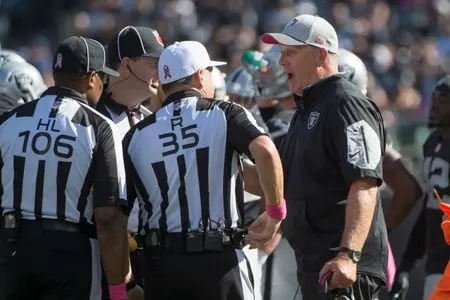
Late hits are already on the list of plays the league is considering as entry points for booth flags. Late hits. The single most contested call in football, where the margin between legal and a penalty is sometimes a tenth of a second and one official’s read on when the ball left the quarterback’s hand. The on-field crew blows those in both directions every single week, and they’re watching it live. A booth official with a monitor is now going to second-guess them without being asked, on a category of play where reasonable people disagree constantly, with no coach having to burn a challenge and no skin in the game whatsoever. The Derick Hall stomp and a bang-bang hit on a slot receiver in the fourth quarter of a playoff game are both landing in that “non-football acts” bucket, and nobody is going to draw a clean line between them that holds once the pressure is on. There is no line. It’s a judgment call, and judgment calls from anonymous officials in booths are exactly what fans are already losing their minds over.
Here’s the Part the League Isn’t Thinking About
The NFL has a rigged-game problem. It doesn’t matter if it’s true. It matters that a massive portion of the fanbase already believes the league has a team of the moment that gets the calls, that Vegas lines move in ways that shouldn’t be possible if games were random, and that the officiating in big moments bends toward whatever outcome the league’s television partners want. You can think that’s conspiracy-theory nonsense. A lot of fans don’t. And the league’s response to that problem is going to be giving booth officials, who nobody can see, nobody can name, and nobody can question, the ability to throw flags on their own authority in the middle of close games.
Picture the first time it happens in January. Booth official drops a flag on a late-hit call in the fourth quarter. The team that benefits scores. They win by three. Immediately, before the post-game show is even over, half the internet is screaming that the game was scripted, that calls were phoned in from Vegas, that the refs protected the league’s golden team for that particular week. And here’s the thing: the booth official faces exactly zero accountability for that call. No press conference. No grade released. No consequence if he got it wrong. The NFL’s referee accountability structure is already basically nonexistent. Grades are kept internal. The public never sees them. An official can have a historically bad game and be back on the field the next week with no explanation given to anyone. Adding booth officials with unilateral flag authority into that same zero-accountability system doesn’t fix the problem. It multiplies it. Now there are more anonymous decision-makers changing game outcomes with no mechanism for anyone to push back, and the conspiracy theory writes itself in real time.
What Fans Actually Want, and Why the League Won’t Give It to Them
Nobody watching a game on Sunday is sitting there thinking “I really wish there were more officials involved in this.” What fans want is for the officials who are already on the field to be better, and to actually face consequences when they’re not. That’s it. That’s the whole ask. If a crew has a historically bad game that costs a team a win, those officials should answer for it publicly, get docked, get benched, something. Right now they don’t. They get shuffled around, protected by the union, and the league says nothing. The accountability structure that would actually fix bad officiating doesn’t exist, and the NFL has shown no interest in building it.
So instead they’re going to add a booth layer. More officials, less visibility, no accountability, and a direct pipeline to exactly the conversation the league should be most desperate to avoid. The refs don’t need more power. They need less of it, and the ones they already have need to come with actual consequences attached. More flags from more anonymous officials in a booth solves the optics of one Derick Hall stomp and creates a year-round argument about whether the league is fixing games. That’s not a trade worth making. The 2019 season already told them that. Twenty-four fixes out of 101 stoppages, and the rule was dead inside a year. This one won’t last longer.
The only difference is this time, when it falls apart, it’s going to take what’s left of fan trust in NFL officiating down with it.
ROLL WITH HAIL MARY MEDIA
Like this kind of chaos? Stay tapped in.
Follow us on X for live reactions, bad beats, and daily sports rants.
FOLLOW @HAILMARYMEDIA_ ON XNot done yet? CLICK HERE for more blogs.