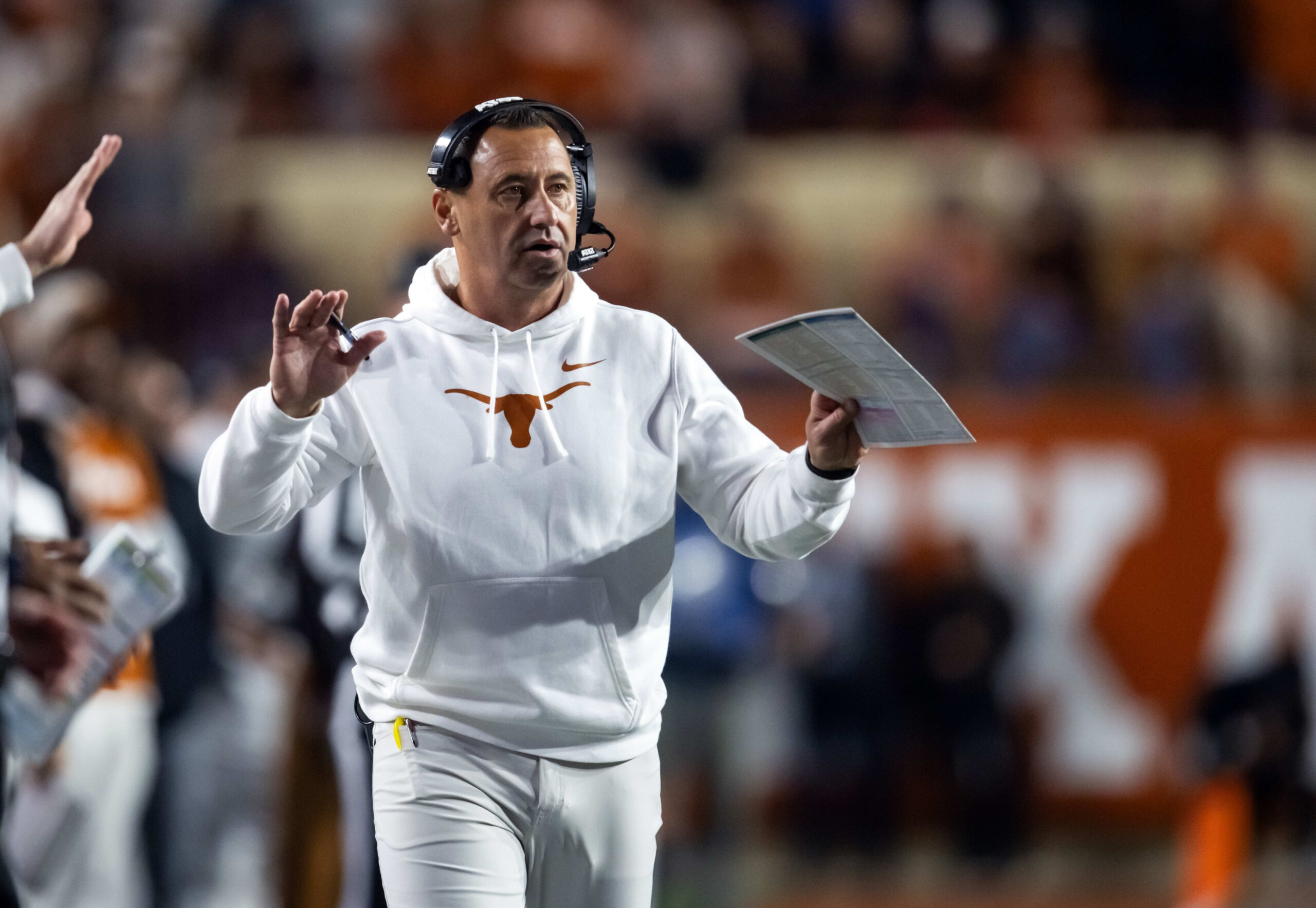

Steve Sarkisian walked off the field on Friday night selling his team like it was a late night infomercial.
Texas had just handed previously undefeated No. 3 Texas A&M a 27-17 beating, finished 9-3, and stacked up three wins over top-10 teams. Arch Manning is on TV saying they’re “absolutely” a playoff team. Sark is talking strength of schedule, marching into Ohio State, and how you shouldn’t punish teams for playing anybody, anywhere.
On the surface, the Texas College Football Playoff resume looks shiny.
You see the ranked wins. You see Columbus and Athens on the schedule. You see Arch. You see the logo.
Look a little deeper, it falls apart.
Because the committee already told us what matters this year. And if they stick to their own standard, Texas is done.
You cannot use “bad losses matter more than head to head” to keep Miami behind Notre Dame, then pretend Texas losing to a 3-8 Florida team in October is just a footnote.
If bad losses really matter, Texas is out. Full stop.
The Rule Of 2025: Bad Losses > Good Wins
The committee did not hide the ball this offseason.
They tweaked the formula, gave strength of schedule more juice, and rolled out a new toy called “record strength.” That metric is built to do one thing:
Reward you for beating real teams, give you almost nothing for handling cupcakes, and crush you if you lose to somebody who stinks.
In practical terms, the scale looks like this:
- Beat a top-10 opponent at home or on the road: huge bump.
- Beat a 4-8 team: congrats, you showed up.
- Lose to a 4-8 team: you pay a tax, and it is supposed to be heavy.
And the committee has already shown they are willing to use that hammer.
Look at Miami and Notre Dame.
Heading into the last rankings, both were sitting at 9-2. Miami beat Notre Dame head to head in Week 1. Miami has wins over Florida and Florida State. Then they close the season 10-2 by blowing out Pitt.
Notre Dame? Also a good team, with two losses to ranked opponents. Solid resume, no problem there.
So why is Notre Dame ahead of the team it lost to?
The committee chair basically came out and said it:
We are comparing the losses. Miami lost to two unranked teams. Notre Dame lost to two teams in our top 13. That is the difference.
Not the helmets. Not the vibes. The losses.
So the message was clear enough for anyone paying attention:
Head to head is nice. Big wins are nice. But if you step on a rake against bad teams, that matters more.
Cool. That is the rule.
Now let’s actually apply it to Texas.
Texas College Football Playoff Resume: Three Big Wins And One Giant Florida Problem
If you are going to rip a team, you at least have to lay out the good first. Texas has plenty of it.
Record: 9-3 overall, 6-2 in the SEC.
Marquee wins, all with Arch Manning at quarterback:
- 23-6 over No. 6 Oklahoma
- 34-31 over No. 9 Vanderbilt
- 27-17 over No. 3 Texas A&M in the renewed Lone Star showdown
All of that matters. Those are big boy wins over top-10 teams, the kind that boost any playoff profile.
Texas also has two losses you can defend all day:
- 14-7 at Ohio State in the opener, where Texas hung around into the fourth quarter in Columbus.
- 35-10 at Georgia in Athens, against an 11-1 machine headed back to the SEC title game.
If that is the entire story, Sark absolutely has a case. A 9-3 team with three top-10 wins and two “good” road losses to playoff-level programs is dangerous and deserving.
But it is not the whole story.
Because sitting right in the middle of that Texas College Football Playoff resume is a boulder with a Gator logo on it.
The Florida Loss Is Exactly What Record Strength Was Built To Punish
Texas went to Gainesville on October 4 as the No. 9 team in the country and walked out with a 29-21 loss to Florida.
At the time, Florida was 1-3 and in freefall. They were desperate, their season already teetering, and they flat out shoved Texas around.
Arch Manning threw two interceptions. The Longhorns ran for only 58 yards. Florida lived in the backfield, took over the line of scrimmage, and punched Texas in the mouth for four quarters.
That was ugly in the moment. It looks even worse now.
Florida finished 4-8, and they were 3-8 this week while everyone on TV was asking if Texas could still sneak into the playoff. They spent all year living near the bottom of the FBS barrel, one of the worst records in the SEC, and multiple outlets have labeled it one of Florida’s worst seasons in decades.
That is not an “unranked but frisky” team. That is not some 7-5 middle-of-the-pack squad that just caught you in a trap game.
That is a bad team.
And that is exactly the kind of loss this new record strength metric was invented to torch.
You lose to 3-8 Florida in October, that is supposed to show up on the ledger in bright red.
If Miami can get punished for losing to unranked but bowl-level Louisville and SMU, there is no honest way to laugh off Texas losing to a team that spent the whole year hanging around 3-8 and 4-8.
Miami vs Notre Dame vs Texas: The Double Standard
If you really want to see the hypocrisy, put all three on the whiteboard.
Miami
- 10-2 overall
- Beat Notre Dame head to head
- Beat Florida
- Beat Florida State
- Two losses to unranked Louisville and SMU, both bowl teams
Notre Dame
- 9-2
- Losses to Miami and Texas A&M, both ranked in the CFP top 13
- No embarrassing loss on the sheet
The committee listened to that and said:
Notre Dame ahead of Miami, because the losses are cleaner. Miami’s “bad losses” outweigh the head-to-head win.
That is their rule, in their words.
Now bring Texas into that same conversation.
Texas
- 9-3
- Three top-10 wins
- Two “good” road losses at Ohio State and at Georgia
- One awful loss at 3-8, now 4-8, Florida
That Florida result makes Miami’s schedule sins look minor. Louisville and SMU are at least solid, bowl-level programs. Florida was a tire fire for most of the season.
So how does this make sense:
- For Miami:
“Your bad losses matter more than beating Notre Dame.” - For Texas:
“Your good wins matter more than getting handled by 3-8 Florida.”
That is not a philosophy. That is a brand hierarchy.
“But Ohio State!” – Why The Big Nonconference Game Isn’t The Issue
Let’s be clear about one thing: Sark is not wrong about the scheduling problem.
Texas going to Columbus in Week 1 and losing 14-7 in a slugfest is the exact type of game we should encourage. You should not get punished for that. If anything, you should get bonus respect for taking that shot.
Same with playing at Georgia. You schedule the two monsters of the Big Ten and SEC in the same season, you are not ducking anybody.
The fear coaches and ADs have is simple. If you take those swings and the committee dings you anyway, why not just cancel the trip and write Missouri State a check to come to your place instead?
On that part, Sark is absolutely right.
But here is the problem for Texas.
The Ohio State loss is not the issue. Georgia is not the issue. You could basically move those to the side of the ledger and still have a playoff argument.
The issue is Florida.
You cannot say “do not punish us for playing at Ohio State” and then also say “please ignore that we lost to one of the worst teams in the SEC.” You do not get to hide behind the brave scheduling shield when your most damaging loss is to a team your peers simply do not lose to.
If the committee really wants to protect teams for scheduling giants, that should make bad losses hurt even more, not less. Otherwise the message to the sport is completely backwards.
What Texas Jumping In Would Really Tell Every AD
Now zoom out and look at who Texas would have to climb over.
- Miami, 10-2, with a win over Notre Dame and no loss as bad as Florida.
- Notre Dame, 9-2, with two ranked losses and no bottom-of-the-barrel faceplant.
- BYU, 10-1, with a single loss to a ranked team.
- Utah, 9-2, with two respectable Big 12 losses and nothing remotely like 3-8 Florida.
- Vanderbilt, 9-2, a team Texas actually beat, but again, no Florida-sized crater in their resume.
You can absolutely argue that Texas might be better on a neutral field than some of those teams. I would probably pick Texas over a couple of them myself.
But that is exactly what the record strength metric was installed to fix.
The whole point was to move away from “who do you think would win on a neutral field” and move toward “what did you actually do from September through November.”
If Texas, with a 29-21 loss to one of the worst records in the SEC, jumps cleaner resumes because the logo is burnt orange and Arch Manning prints ratings, then the whole system is just a TV show.
And that brings us back to your favorite Missouri State example.
If the committee lets this version of Texas into the playoff, the real lesson for every AD is not “schedule Ohio State.” It is:
As long as you win a couple of big TV games and you are a blue-blood, you can survive a catastrophic loss. So do not risk adding another.
Swap that Ohio State trip for a home opener against Missouri State or Eastern Nowhere Tech. Go 11-1 against a softer schedule. The committee will still find a path for you if the brand is strong enough.
That is the opposite of what they claim to want.
Texas Is Scary. That Is Not The Same Thing As Deserving.
All of this can be true at once:
- Texas is one of the most dangerous teams in the country right now.
- Arch Manning is playing his best ball, and the offense finally looks like what Sark has been promising.
- Nobody is lining up begging to see Texas on a neutral field in December.
None of that automatically equals “deserves a playoff spot.”
The playoff is supposed to be earned over twelve or thirteen games, not imagined in some neutral field thought experiment.
And by the committee’s own words:
- They created record strength to punish bad losses harder.
- They just told Miami that its “bad losses” are more important than beating Notre Dame head to head.
- They have already pointed at Texas’s loss to Florida as a major reason the Longhorns are sitting way down the rankings instead of in the top 10.
You cannot say all that, then wipe it off the whiteboard because Texas finished strong, beat a rival in primetime, and the burnt orange looks good in the bracket graphics.
If bad losses matter, the Florida game is a torpedo.
If bad losses do not matter, Miami should be ahead of Notre Dame and we can stop pretending this record strength thing is anything other than a prop.
The Double Standard In One Sentence
Here is the whole conversation boiled down:
If Miami cannot be ranked ahead of Notre Dame at 10-2 with a head-to-head win because its losses are “too bad,” then 9-3 Texas with a loss to 3-8 Florida has no business in the playoff under that same standard.
That is it. That is the rant.
You do not get to bury Miami for Louisville and SMU, then act like losing to a 3-8 Florida team in October is no big deal because Texas closed the year by beating A&M in a made-for-TV reboot.
Either bad losses matter for everyone, or they are optional for the brands the committee likes most.
So Now What? Your Turn To Be Honest
If you are still reading, you already have a take. So let’s just spell it out and see where you land.
- Would you rather take 10-2 Miami, with no loss worse than SMU or Louisville, or 9-3 Texas, with a loss to 3-8 Florida, into the playoff?
- If Texas gets in anyway, should every AD in America ditch the Ohio States and Georgias and start writing checks to FCS schools instead?
- Do you honestly believe a BYU, a Utah, or even Miami would get the same mercy if they had a 29-21 loss to 3-8 Florida on their sheet?
- And most important, does the playoff still feel legit if “bad losses matter” only applies to teams without a giant brand behind them?
Drop your top 12 in the comments and do it straight.
If we really use the “bad losses matter most” standard the committee just laid out, where should Texas actually be on your board, and is that anywhere near a playoff spot?