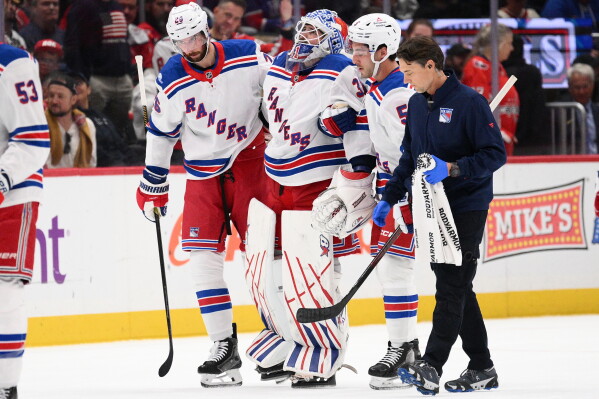
This weekend in the NHL started out rather quietly. After the Darren Radysh and Michael Kesselring trades, not much seemed to be happening. Sure, plenty of rumors were swirling, as they always are this time of year. Sunday saw an uptick in action and ended in a blockbuster, and it might be the clearest sign yet that the NHL parity problem is getting out of hand Florida moved offer sheet candidate Mackie Samoskevich to Seattle for quite a few picks, including the 25th pick in this year’s draft.
Seattle kept making moves as they resigned one of the more intriguing free agents, Bobby McMann. All and all, it was a pretty good Sunday for Seattle. Sure, the price seemed pretty high for Mackie especially because an offer sheet would have had them spending less in terms of assets, but Seattle needs to get deeper.
Florida also continued to make moves, except their moves carried significantly more weight in terms of the league (and league parity). Just a few hours after collecting the 25th overall selection, to go with their 9th overall selection, they decided to move both picks to acquire Brady Tkachuk. Florida also attached a 2029 1st and 2030 2nd in the deal. The NHL rarely sees trades of this magnitude. A Bonafide star, like Brady, just so rarely changes teams via trade in this league that it was completely shocking. Brady hinted at wanting a change of scenery but never formally requested a trade, at least not to the public’s knowledge. Nevertheless, something occurred during conversations with Brady that made him submit a list of four teams that he would be willing to go to. Those teams were Vegas, Florida, Carolina, and Minnesota. Three of those four teams have very clear ties to the USA Olympic team. Two of those teams have no state income tax, and two of them also just played for the Stanley Cup. However, only one of those teams included his brother on their roster and ultimately that’s where he went.
While this trade is fascinating, is it a bad thing for the league? Let’s talk about it.
For starters, it is becoming abundantly clear that there is some sort of collusion, or tampering, occurring within the Team USA group chat. Brady’s trade list is almost identical to that of Dylan Larkin’s. Quinn Hughes was already moved to Minnesota where the Team USA GM is also managing the team. There are also rumors circling Connor Hellebuyck also going to Florida, or Vegas. It’s understandable to see a gold medal create a long-lasting bond between the teammates of team USA but they are all clearly conspiring to play with each other at the NHL level which makes all the other GM’s hamstrung to make impactful trades. Here in lies the first “bad” thing for the league, too many no movement clauses. The only reason all these team USA guys can force these moves, which also includes Vinny Trochek wanting to go to Minnesota or Florida, because they all have some sort of trade protection. It’s a very bad thing for the league to be honest. Obviously, you don’t want to acquire a star player who doesn’t want to play within your organization but the fact they can limit their trade locations severely reduces the trade cost of acquiring a star player. Florida’s price appeared to be steep, but in reality, they lost zero players off their active roster. Ottawa had to settle for lottery tickets, some of which are four years away. Even if Ottawa is to draft someone of Brady’s caliber, they aren’t likely to see in a Sen’s sweater for at least three seasons. In a true open market for Brady, you can almost guarantee that Ottawa would have received a better return. Florida doesn’t care about the picks they traded, none of them would have been contributors while their cup window was still open. It’s clearly a lopsided win for Florida, and it all happened because no movement clauses tied Ottawa’s hands.
The NHL Parity Problem
The bigger issue, and one that is more talked about, is the state income tax problem. I have long disagreed that this is an issue, but my stance is changing. I think teams have to be good to weaponize it, but teams have clearly used it to get good and stay good. Vegas, Tampa, and Florida are all elite teams, and they all use their tax advantages to continue to bring in top-tier talents. The reason this is becoming an issue is due to how much the players are making in the NHL compared to the rest of the big 4 sports. In other leagues, the tax advantages are nice, but they don’t make too much of a difference given the absurd amount of money those players are making. For NHL players, the earning difference is actually quite significant due to the lower salaries. Florida shouldn’t have the ability to bring in Brady with all of the great players they already have; the cap system should stop it from happening. However, almost everyone on Florida is making less than market value due to the no state tax situation. Hell, Florida still has 7 million dollars available in cap space, and they have three lines full of Olympians. Vegas is really no different, and I expect them to add a superstar before the end of the offseason (again). Personally, I think trades is an area that abuses the tax situation the most. It almost goes hand-in-hand with the no movement clause issue. In free agency, teams can opt to spend more on a player to offset the tax issue. However, in a trade a player already has a contract signed (in most cases) so his salary isn’t changing. Therefore, if a player like Brady is traded, and he has control over the situation, why would he not want to go somewhere that essentially gives him a raise? It’s not a fluke that more and more players are forcing their way to Vegas and the state of Florida, sure the weather helps, but nothing helps more than playing on a good team with extra cash in your pocket.
I’m not even sure how you fix the issue. You can create a cap system that adjusts for your tax situation? However, that still doesn’t solve the problem of player movement via trade. I’m sure there’s a solution though, and they need to find it fast. The reason they need to find it is because you might slowly lose all competitive balance in the league. If all the good/great players continue to force their way to the list of six teams that provide tax advantages, the remaining 26 teams are completely screwed. The NHL is so compelling, especially come playoff time, is because every team seems to have a chance. If more players like Eichel, Tkachuk(s), Marner, Rantanen, Marchand, Stamkos, and Guentzel just continue to go to income tax free states the parity will disappear.